
This website is designed and maintained by Jeff Bagnall
Last Updated: Tuesday,
November 13, 2012
© Dunston Webmaster 1997 -


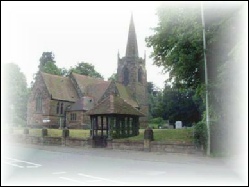

In the middle ages, Dunston was subject ecclesiastically to the large and important
Collegiate Church of St. Michael at Penkridge, a royal peculiar whose dean was from
1215 the Archbishop of Dublin. The prebend of Dunston, land amounting to perhaps
50 acres, supported one of the canons of St. Michael's. The prebend was established
some time before 1261 and was worth £5 6s. 8d. (£5.33) in 1291. The village church
has been dedicated to Leonard of Noblac, a saint concerned with the liberation of
prisoners, since at least the 15th century, as Richard Talbot, the dean and archbishop,
confirmed this dedication in 1445 whilst declaring a hundred day indulgence for all
who would visit it and make a contribution to it. The prebendaries of Dunston were
responsible for the cure of souls in the village. Prebendaries in royal chapels were
generally absentees and paid vicars to do their work for them, but no vicarage was
apparently established for Dunston-
In 1548 the Penkridge college under the terms of the Chantries Act of 1547, a crucial part of the Reformation legislation of Edward VI's reign. A vicar was appointed at Penkridge, along with an assistant, and this arrangement persisted for several centuries. Ultimate control, however, rested with the successors to the royal peculiar. From 1585, this was the Littleton family of Pillaton Hall, soon to become the Littleton Baronets, and later Barons Hatherton. They had advowson, the right to appoint clergy in the parish, and were not subject to the ordinary, the Bishop of Lichfield. The little church at Dunston was termed a chapel of ease with cure of Penkridge but no specific appointment was made to it: it was simply part of a wider parish, served by two clergy, with the curate generally attending to services at Dunston. Only with the final winding up of the peculiar in 1858 and the establishment of a separate parish was the way was clear to provide adequate pastoral care through the establishment of a separate benefice. From 1868 the parish had a titular vicar, and from 1892 the benefice was merged with that of Coppenhall. A new building was erected at the expense of the Perry family
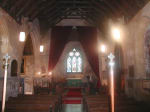
The village church of St. Leonard's is medium sized, of Neo-
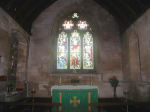
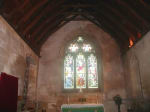
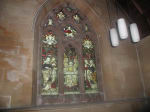
The church contains memorial tablets to Thomas Perry (d. 1861), in whose memory the
church was built, to his widow Mary (d. 1881), and to later members of the Perry
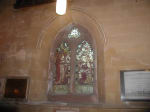
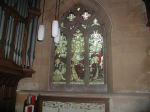
family who lived at nearby Dunston Hall. There are memorial windows and a tablet
to members of the Hand family including Charles Frederic Hand (d. 1900), also tablets
to John Taylor Duce (d. 1886), Albert Pickstock (d. 1926), and three members of the
Thorneycroft family (d. 1913, 1924, and 1943). The two bells of the ancient chapel
in 1553, were replaced by one bell in the new church by 1889. This arrangement was
then replaced in 1890 by a carillon of eight tubular bells, rung from a keyboard,
donated by Mrs. Perry of Dunston Hall. The carillon is in need of restoration and
the single bell is use at appropriate times. In the 1980's Dunston Parish owing to
low attendances at many of the services, it was decided that Dunston and Coppenhall
no longer warranted a sole Vicar. Consequently, Dunston's religious interests are
in the hands of a Team Vicar who also looks after the churches in Acton Trussell
and Bednall in the Penkridge Team Ministry.
In 1548 the Penkridge college under the terms of the Chantries Act of 1547, a crucial part of the Reformation legislation of Edward VI's reign. A vicar was appointed at Penkridge, along with an assistant, and this arrangement persisted for several centuries. Ultimate control, however, rested with the successors to the royal peculiar. From 1585, this was the Littleton family of Pillaton Hall, soon to become the Littleton Baronets, and later Barons Hatherton. They had advowson, the right to appoint clergy in the parish, and were not subject to the ordinary, the Bishop of Lichfield.[6] The little church at Dunston was termed a chapel of ease with cure of Penkridge but no specific appointment was made to it: it was simply part of a wider parish, served by two clergy, with the curate generally attending to services at Dunston. Only with the final winding up of the peculiar in 1858 and the establishment of a separate parish was the way was clear to provide adequate pastoral care through the establishment of a separate benefice. From 1868 the parish had a titular vicar, and from 1892 the benefice was merged with that of Coppenhall. A new building was erected at the expense of the Perry family
The village church of St. Leonard's is medium sized, of Neo-
The church contains memorial tablets to Thomas Perry (d. 1861), in whose memory the church was built, to his widow Mary (d. 1881), and to later members of the Perry family who lived at nearby Dunston Hall. There are memorial windows and a tablet to members of the Hand family including Charles Frederic Hand (d. 1900), also tablets to John Taylor Duce (d. 1886), Albert Pickstock (d. 1926), and three members of the Thorneycroft family (d. 1913, 1924, and 1943). The two bells of the ancient chapel in 1553, were replaced by one bell in the new church by 1889. This arrangement was then replaced in 1890 by a carillon of eight tubular bells, rung from a keyboard, donated by Mrs. Perry of Dunston Hall. The carillon is in need of restoration and the single bell is use at appropriate timesIn the 1980's Dunston Parish owing to low attendances at many of the services, it was decided that Dunston and Coppenhall no longer warranted a sole Vicar. Consequently, Dunston's religious interests are in the hands of a Team Vicar who also looks after the churches in Acton Trussell and Bednall in the Penkridge Team Ministry.
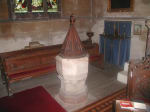
This church is situated in the lovely hamlet of Dunston in south Staffordshire. It
is easily accessible from Junction 13 of the M6 Motorway, by taking the A449 towards
Wolverhampton.
The village of Dunston starts just after you leave the motorway junction,
and the church is approximately 1/2 mile on your right. The Ordnance Survey Grid
Reference for the Church is SJ 928177
the Postcode is: ST17 9AG
South Staffordshire Council Web Site
The church has an active Sunday School (Church Mice) and we welcome young people
to meet with us during the Sunday service for faith based creative craft work. There
is also a very strong connection with St. Leonard’s First School in School Lane,
Dunston.
The congregation is steadily growing in size and currently our two main projects
are to replace the outdated heating system and obtain funding for the repair of the
church tower. We welcome enquiries for weddings, Baptisms and other special services
-

